
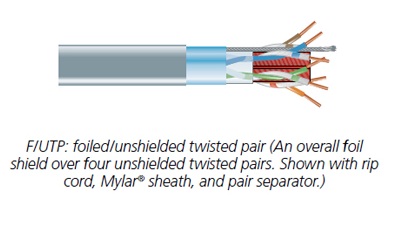
 One of the most obvious advantages copper offers is that it is less expensive than fiber cable and much easier to terminate in the field. The type of cable you choose depends on the environment and application.
Twisted pair cable used in networking applications typically consists of four pairs of 22–28 AWG copper wires, each covered by insulators and twisted together. There are two types of twisted pair cable, unshielded and shielded.
Shielded vs. unshielded cable:
Unshielded twisted pair:
This is the most widely used cable. Known as balanced twisted pair, UTP consists of twisted pairs (usually four) in a PVC or plenum jacket. When installing UTP cable, make sure you use trained technicians. Field terminations, bend radius, pulling tension, and cinching can all loosen pair twists and degrade performance. Also take note of any sources of EMI. Choose UTP for electrically quiet environments.
Shielded twisted pair:
Over the past twenty years, the need for speed in networking has driven new cabling specifications and technologies at an ever-accelerating rate. Alongside the development of each generation of Ethernet are corresponding developments in cabling technologies. Part of that development is the increased use of shielded cable. It’s becoming more common in high-speed networks, especially when it comes to minimizing ANEXT in 10-GbE runs.
Read full article by Black Box
Buty Nike Damskie Wyprzedaż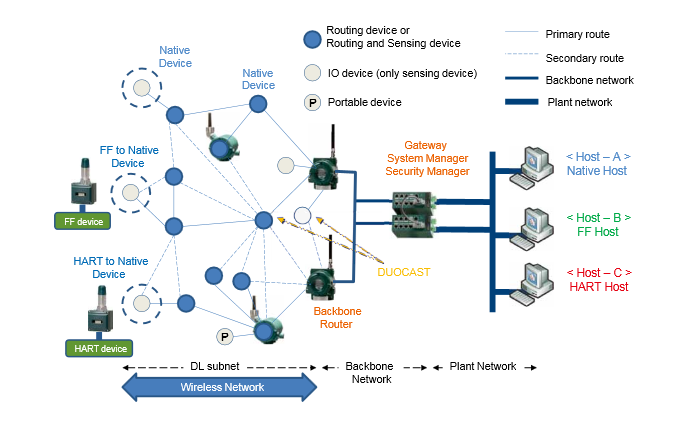 One of the international wireless standards for industrial use, ISA10 0.11a, was first established in 2009. Since then, wireless has been introduced into many industrial areas, and the recognition of industrial wireless technology has continued to grow as application examples increase. Nowadays, the use of wireless is spreading further, and various types of sensors are beginning to be required. Even for existing systems using wired communications, wireless technology is considered as a communication means to collect information from already installed field devices, for example, diagnostic information concerning the devices.
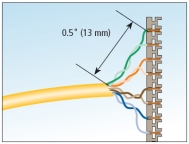 Blog via BlackBox: You can invest in the best cable and hardware, but if they’re not installed properly, they won’t work, or at least they won’t work well. Protect your investment and follow these installation guidelines.
 White paper by Opto22: Automation engineers on LinkedIn heatedly debate the pros and cons of using standard COTS smartphones and tablets in industrial settings. Meanwhile, industry analysts like Gartner and ARC Advisory Group forecast tremendous growth in BYOD (bring your own device) usage.
.gif) Moxa, an innovative leader in industrial automation, recently released an updated reference guide for wireless networks. The guidebook provides general wireless knowledge ranging from wireless landscapes (WLAN, WWAN, and WPAN basics), radio system concepts, antenna/cable/connector selection, and a brief introduction to industrial wireless environments.
Moxa, an innovative leader in industrial automation, recently released an updated reference guide for wireless networks. The guidebook provides general wireless knowledge ranging from wireless landscapes (WLAN, WWAN, and WPAN basics), radio system concepts, antenna/cable/connector selection, and a brief introduction to industrial wireless environments.