02042026Wed
Last updateSun, 04 Feb 2024 4am

Rockwell Automation CEO to address on Scalable Internet of Things Technologies

Keith D. Nosbusch, chairman and CEO of Rockwell Automation, will address how scalable industrial Internet of Things (IoT) technologies enhance The Connected Enterprise, a transformational vision for higher productivity, sustainability and global competitiveness.

Nosbusch will deliver a keynote presentation at the third annual Internet of Things World Forum 2015 http://www.iotwf.com/ hosted by Cisco from Dec. 6-8 in Dubai, United Arab Emirates. The forum attracts key stakeholders and innovators in business, government, and academia who are driving adoption of the Internet of Things worldwide.

“The Connected Enterprise will drive more change in industrial automation in the next 10 years than we’ve seen in the past 50,” said Keith D. Nosbusch, chairman and CEO, Rockwell Automation. “This transformation creates tremendous opportunities for those who take advantage of it, and great risks for those unprepared for a strategic response.”

Nosbusch will explain how it is now possible to transform high volumes of real-time data from industrial operations into actionable insights that accelerate optimization of plants and supply networks. “A scalable implementation of industrial IoT technologies enhances this transformation using smart, connected assets and real-time analytics that function as an important part of an integrated control and information system,” said Nosbusch.

Nosbusch’s keynote will highlight applications of industrial IoT technologies in a wide spectrum of industries such as oil and gas and consumer packaged goods. A high performance architecture, built upon secure IP-based networks and complemented with contemporary technologies such as mobility, data analytics and cloud computing, is essential for industrial IoT, and also makes it possible to achieve seamless convergence between OT systems and enterprise IT systems.

Kobe 11 ELite Glowing
Cost Effective PROFINET / EtherNetIP Remote I/O Modules

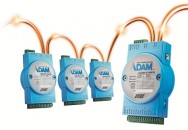
Advantech IAG has announced the launch of ten ADAM-6100EI/PN I/O Modules designed to work directly with PLCs over EtherNet/IP and PROFINET.

In certain scenarios, these cost effective modules take the place of couplers when deploying I/O over a long distance and since they have dual Ethernet ports they can be daisy-chained every one hundred meters to collect data from and control the machines. One of the key advantages, and useful in a wide variety of scenarios, is ADAM-6100 series can be daisy- chained using Ethernet. This provides a cost effective solution to transmitting data over much longer distances than with PLCs.

For the benefit of central configuration across multiple machines, the ADAM-6100 using the ADAM.NET Utility, can create projects in L5K, a proprietary file format used by AB PLCs. EDS files, for the EtherNet/IP protocol, and GSD files for the PROFINET protocol formats are for use on a whole hostof third party PLCs.

To ensure the ADAM-6100 series and the data they carry are protected at all times from the harshness of the vagaries of a factory’s’ electrical supply, the ADAM-6100 series have 2,500 VDC isolation protection.

In various scenarios, signal decay and noise are prevented by placing ADAM-6100 AI modules near the sensors before sending data directly to the PLC which can be placed much further away and can receive data from multiple ADAMs in different locations. Because of their ease of installation, these ADAM modules are suitable for a wide range of environments.

The PROFINET Modules are: ADAM-6117PN- 8-ch Isolated AI; ADAM-6150PN-15-ch Isolated DI/O; ADAM-6151PN-16-ch Isolated DI; ADAM-6156PN-16-ch Isolated DO and ADAM-6160PN- 6-ch Relay Output.

The EtherNet/IP Modules are: ADAM-6117EI- 8-ch Isolated AI; ADAM-6150EI-15-ch Isolated DI/O; ADAM-6151EI-16-ch Isolated DI; ADAM-6156EI-16-ch Isolated DO and ADAM-6160EI-6-ch Relay Output.

Air Max

Yokogawa Enhanced STARDOM™ Network-based Control System developing new CPU Module

Yokogawa Stardom.jpgYokogawa Electric Corporation has announced that it will release an enhanced version of the STARDOM™ network-based control system in the spring of 2016 that includes a newly developed high-speed CPU module for the FCN autonomous controller. Based on the concept of putting forward a product that is Faster, Stronger, Smarter, STARDOM will feature the new CPU module, improved environmental resistance, and an enhanced engineering tool. With this product, Yokogawa intends to expand the open network control system business.

The STARDOM system will be exhibited at the Measurement and Control Show 2015 Tokyo, which will be held December 2 – 4 at the Tokyo Big Sight exhibition center. Development Background includes:

STARDOM is a network-based production control system that consists of the FCN autonomous controller and the VDS or FAST/TOOLS SCADA software. Since introducing this system in 2001, Yokogawa has continued to enhance it by adding new functions to satisfy customers' needs. Combining the reliability of a distributed control system (DCS) with the versatility and economy of a programmable logic controller (PLC), STARDOM is widely used in medium-size manufacturing plants and in geographically distributed applications such as natural oil and gas wells. To date, more than 20,000 STARDOM systems have been delivered.

STARDOM's FCN autonomous controller will be capable of reliably controlling high-speed equipment such as compressors, large wind power generators, and other types of turbines, and will be able to operate in a wider range of climatic conditions. Moreover, it will include a function that aids engineers in the performance of installation, modification, and maintenance tasks.

Product Features includes:

  • High-speed calculation and communication
  • Strengthened environmental resistance
  • Improved efficiency of engineering and maintenance work
adidas nmd damen schwarz rosa

Yokogawa releases CENTUM VP R6.02 Integrated Production Control System

Yokogawa Electric Corporation announces the December 2 release of CENTUM VP® R6.02, a new version of the company's integrated production control system with enhanced functionality.

Ever since launching the CENTUM series 40 years ago, Yokogawa has continued to improve its flagship product. In keeping with Yokogawa's VigilantPlant® vision for the control business, the company has developed a number of new operation and monitoring functions for CENTUM VP, the latest generation in the CENTUM series, that will make it easier for operators to keep track of what is happening in a plant.

Oil refineries, petrochemical plants, and other downstream facilities have numerous suppliers to choose from and must deal with considerable variability in the composition of the raw materials that they receive, necessitating a number of changes to their processes. Further changes are necessitated by aging facilities and the need to vary production volumes to meet fluctuating demand. To respond to these challenges and ensure the safe and efficient operation of plant facilities, operators must be able to quickly and thoroughly check many different kinds of data.

Enhancements:

  • Real-time trend function for a clearer understanding of plant conditions
  • Preventing alarms from being misplaced or overlooked during handovers
  • Tight integration with ProSafe-RS R4.01
adidas

PlantPAx MPC moves Model Predictive Control Software to the Control System

Rockwell Automation will release PlantPAx model predictive control (MPC) software, which for the first time embeds fully functional MPC technology into Logix controllers to help maximize equipment performance. When used in process applications ranging from consumer to heavy industries, PlantPAx MPC can improve overall control in a single machine or an entire line to help maximize throughput, increase yield, reduce quality variability and improve energy usage.

PlantPAx MPC is included in the latest release of the PlantPAx modern distributed control system.

“By embedding MPC into the control system, PlantPAx MPC simplifies integration and improves ease of use,” said Mike Tay, product manager, Rockwell Automation. “It also delivers several performance advantages over single-loop PID controllers. These include better multivariable coordination, predictable handling of outside disturbances, improved management of long or complex processes and predictive response to process constraints, all resulting in maximizing equipment performance while safely operating within process limits.”

Multivariable Coordination: PlantPAx MPC delivers better coordination of multivariable actions in complex process applications to maximize controller performance and maintain quality. A single control-system-based MPC module supports up to five separate MPC applications, and each of those applications can support up to 10 controllable variables and 10 manipulated variables.

Predictably Handle Outside Disturbances: The software provides the ability to measure disturbance variables that can’t be controlled, such as ambient humidity. Once detected, the system can predictably respond to these disturbances as needed to keep the process optimized.

Manage Long and Complex Processes: Both operators and control systems can struggle when managing long and complex processes for applications, such as dryers and kilns. PlantPAx MPC uses dynamic explicit modeling to identify and program the specific responses and requirements for these processes.

Predictive Response to Constraints: PlantPAx MPC dynamically predicts process behavior against identified constraints and makes proactive adjustments to maintain process performance within identified limits.

Maximize Equipment Performance: Dynamic and steady-state constraints can be enforced in the software to maximize equipment performance up to its limits. For example, enforcing a flooding constraint in a distillation process can help feed levels at their highest without the risk of flooding.

PlantPAx MPC will be on display at the Process Solutions Booth 1078 during the 2015 Automation Fair event from Rockwell Automation, taking place Nov. 16 to 19 at McCormick Place West in Chicago. It will also be featured in the session “Applications for PlantPAx MPC” at the Process Solutions User Group (PSUG) during the Automation Fair event.

Apparel

Rockwell Automation releases Quality Management Application connecting Plant-Floor

A new, comprehensive, quality-management application from Rockwell Automation allows manufacturers to more easily and efficiently model and enforce in-process quality regimens. The Quality Management fit-for-purpose application (app) is an out-of-box, stand-alone application that is scalable to include other fit-for-purpose apps within the FactoryTalk ProductionCentre manufacturing execution system (MES) from Rockwell Automation.

Through tight integration with automation and business-level quality-management systems, the Quality Management fit-for-purpose app collects and exchanges data quickly, so nonconformance issues are identified before product leaves the plant.

“Our customers are working to connect plant-floor data with enterprise resource planning (ERP) systems and business analytics to increase productivity and better manage global operations,” said Todd Montpas, product manager, MES Software, Rockwell Automation. “This solution fills a gap for those producers who might not have large MES infrastructures, but want to move away from disparate or antiquated paper-based quality systems. And it’s designed to grow with them when they expand into other MES solutions and become a more Connected Enterprise.”

Using a built-in notification engine, the fit-for-purpose app quickly alerts personnel when a quality check needs to be completed. If the check fails, a configurable escalation work flow drives operations into additional quality sampling and corrective action plans, creating the potential to salvage product still on the line. This also gives plant and operations managers insight into the total number of completed, suspected and wasted batches.

The Quality Management fit-for-purpose app has the ability to run as a true thin-client application on desktops and a variety of devices, further reducing the cost and complexity of the quality system.

More Info

Nike

Rockwell Automation enhances Studio 5000 Software for more efficient System Development

Rockwell Automation has added three new applications to its Rockwell Software Studio 5000 development environment to help engineers speed development of automation systems as they design a Connected Enterprise. These applications, along with the Studio 5000 Logix Designer application released in 2012, bring more functionality together into one environment to help improve automation design productivity.

“The addition of these applications significantly enhances our integrated development environment,” said Mike Brimmer, product manager, Rockwell Automation. “The expanded environment simplifies the design process and reduces the need for multiple tools, providing a more seamless system development experience.”

The Studio 5000 environment now includes the following:

The new Studio 5000 Architect application is the central point within the Studio 5000 environment where users can view the overall automation system; configure devices such as controllers, HMIs and EOIs; and manage the communications between the devices. The Studio 5000 Architect application also exchanges data with other Studio 5000 applications and third-party electrical design tools to simplify the development experience.

The Studio 5000 Logix Designer application is the design and maintenance software for the Allen-Bradley Logix5000 family of controllers and is used to configure discrete, process, batch, motion, safety and drive control. It simplifies the design process by providing an application-centric view of code; enhanced work flows for more efficient re-use of content; and collaborative tools that make it easier for multiple people to work together.

The new Studio 5000 View Designer application is the design and maintenance software for Allen-Bradley PanelView 5500 graphic terminals. The Studio 5000 View Designer application provides an intuitive, modern design environment that helps users more easily build contemporary systems. It enhances integration between the control system and operator interface to improve programming efficiency and runtime performance.

The new Studio 5000 Application Code Manager speeds system development by helping users build libraries of re-usable code that can be managed and deployed across their entire enterprise. Creating projects with Application Code Manager helps improve design consistency, reduce engineering costs, and achieve faster time-to-market and commissioning.

In addition, Rockwell Automation has updated the Studio 5000 environment with enhanced security and localized batch control. New security features include more user-authentication and access-control options, and a new privilege escalation capability. These features help improve productivity and system uptime by granting users the right level of access at the right time. Localized batch control allows controller-based batch sequencing and eventing to simplify system architecture for single-unit control and process skids.

nike

Yokogawa achieves Hot Cutover at Chevron Bangladesh Gas Plant with new Upstream Solutions

suc-chevron-bangladesh-004.pngChevron Bangladesh is the largest natural gas producer in Bangladesh, who is supplying approximately 50 percent of Bangladesh’s natural gas consumption. Through subsidiaries, Chevron Bangladesh produces natural gas and condensate from three fields at Bibiyana, Jalalabad and Moulavi Bazar, in northeast of Bangladesh. Bibiyana Gas Plant is located at the Bibiyana field in Block 12 of the Habiganj District, Sylhet Division. The plant is approximately 150 kilometers in the northeast of Dhaka.

The existing gas plant had four gas processing trains. In order to process increased natural gas volumes from the Bibiyana field, the Bibiyana Expansion Project (BYX) was launched to add two new gas processing trains with additional development wells and an enhanced gas liquids recovery unit.

Project Background:

Chevron Bangladesh was looking for a process automation system for which operations can control the plant safely at its optimum performance with minimum downtime and keep the process within the limit of safety operation. Yokogawa offered CENTUM VP as the Distributed Control Systems (DCS), and ProSafe-RS as the Safety Instrumented Systems (SIS) and the fire and gas system(FGS), through the integrated Human Interface Station (HIS) between CENTUM VP and ProSafe-RS. Yokogawa (Thailand) Limited received a purchase order to replace Allen Bradley PLCs at the existing four gas processing trains with CENTUM VP and ProSafe-RS, and install CENTUM VP and ProSafe-RS at the two new gas processing trains. Yokogawa Engineering Asia Pte. Ltd. provided the engineering work and Yokogawa India Limited commenced the site activities for erection/commissioning and startup support to complete the project.

Yokogawa’s scope of work includes engineering, supply of CENTUM VP, ProSafe-RS, the DPharp (EJA-E) pressure/differential pressure transmitters, the YTA temperature transmitters, the ROTAMASS Coriolis Flowmeters, the Rotameter Variable Area Flowmeters, the Plant Resource Manager (PRM) asset management package, the Unified Gateway Station (UGS) subsystems integration package, the Advanced Operating Graphics (AOG) consultation and implementation for HMI graphics, Network Security Solution service, Alarm Management System, CCTV package, Data Historian, Vibration Monitoring System, and Erection and Commissioning/Startup support.

Download Full Story

Running Shoes & Gear

Honeywell Technology to drive Iraq’s most Advanced Refinery

Honeywell has announced that it will provide industry-leading process technology and advanced automation controls to Iraq's Karbala refinery, now under construction in Karbala Province, about 120 kilometers south of Baghdad.

The grassroots refinery will use industry-leading refining processes from Honeywell UOP and automation controls from Honeywell Process Solutions (HPS) to allow Iraq's State Company of Oil Projects' (SCOP) Karbala refinery to maximize production of fuel and other products that will help offset the more than 350,000 barrels per day of refined products the country currently imports. These technologies will also help meet growing domestic demand with products meeting international standards equivalent to Euro V fuel standards. Startup of the 140,000 barrel-per-day refinery is expected in 2020.

"The Honeywell solution combines UOP's deep process knowledge with HPS's expertise in plant automation to make the refinery run at the top of its capability," said Mike Millard, vice president and general manager of Honeywell UOP's Process Technology and Equipment business. "The integration of process technology with a controls solution enables the Karbala refinery to make more gasoline, diesel, fuel oil, jet fuel, liquefied petroleum gas and asphalt, and make it more efficiently."

"Honeywell has a great track record of successful projects implemented in Iraq," said Pieter Krynauw, vice president and general manager of HPS' Projects and Automation Solutions business. "When we combine UOP process technology with the HPS automation and controls, refineries will be able to reach peak performance faster and lower the total cost of ownership while getting the best return of investment for the project lifecycle."

Honeywell technologies licensed for the Karbala refinery include:

The UOP Penex™ process to upgrade light naphtha feedstock to produce isomerate, a cleaner gasoline blend-stock that does not contain benzene, aromatics or olefins.

The UOP fluid catalytic cracking (FCC) process to convert heavy feedstocks recovered from other refinery operations into high-octane gasoline.

The UOP CCR Platforming™ process to convert low-quality naphtha to high-octane blending components for gasoline.

The UOP Unionfining™ process to improve the quality of distillate boiling-range feedstocks to help meet tougher product specifications.

The UOP Chlorsorb™ process to help meet stringent waste gas specifications.

The Experion® Process Knowledge System (PKS), the heart of the Integrated Control and Safety Systems (ICSS), which unifies people with process, business requirements and asset management by enabling integration of all process control and safety systems and automation software under a single architecture.

Safety Manager, which integrates process safety data, applications, system diagnostics and critical control strategies, and executes defined safety applications in a fully redundant architecture.

Fire and gas safety systems, which include SIL3 certified safety systems connected to fire detectors, fire alarm panels, fire suppression systems, gas detectors, sounders and beacons to minimize the impact of any abnormal situations.

UniSim® training simulators, which enable industrial sites better plan, deploy and manage a structured program for operator competency.

New Balance The Next Wave